TAM stops being a list
Clay is releasing 12 updates in 12 weeks, and first out is Audiences. It looks like a feature. It is really a shift in what a prospecting tool is — from static list to living market.
Not an update. A new Clay.
Clay has been a data sourcing tool. Best in class at finding companies and contacts, enriching them, and pushing them into a sequence. But the actual work — building the list, keeping it relevant, connecting it to the next step — has still sat with the user.
With the 12-week release, Clay moves that part into the product. From data sourcing to growth orchestration. The tool stops producing raw material and starts driving a flow.
First out is Audiences.
The problem Audiences solves
Anyone who has built in Clay for a while will recognise this. Tables and workbooks. No unified database. Companies in one table, contacts in another, different surfaces for different campaigns and cohorts.
The consequence is that you never really have the answer to who your market is. You have the answer to who happened to end up in this particular table on the day you sourced it.
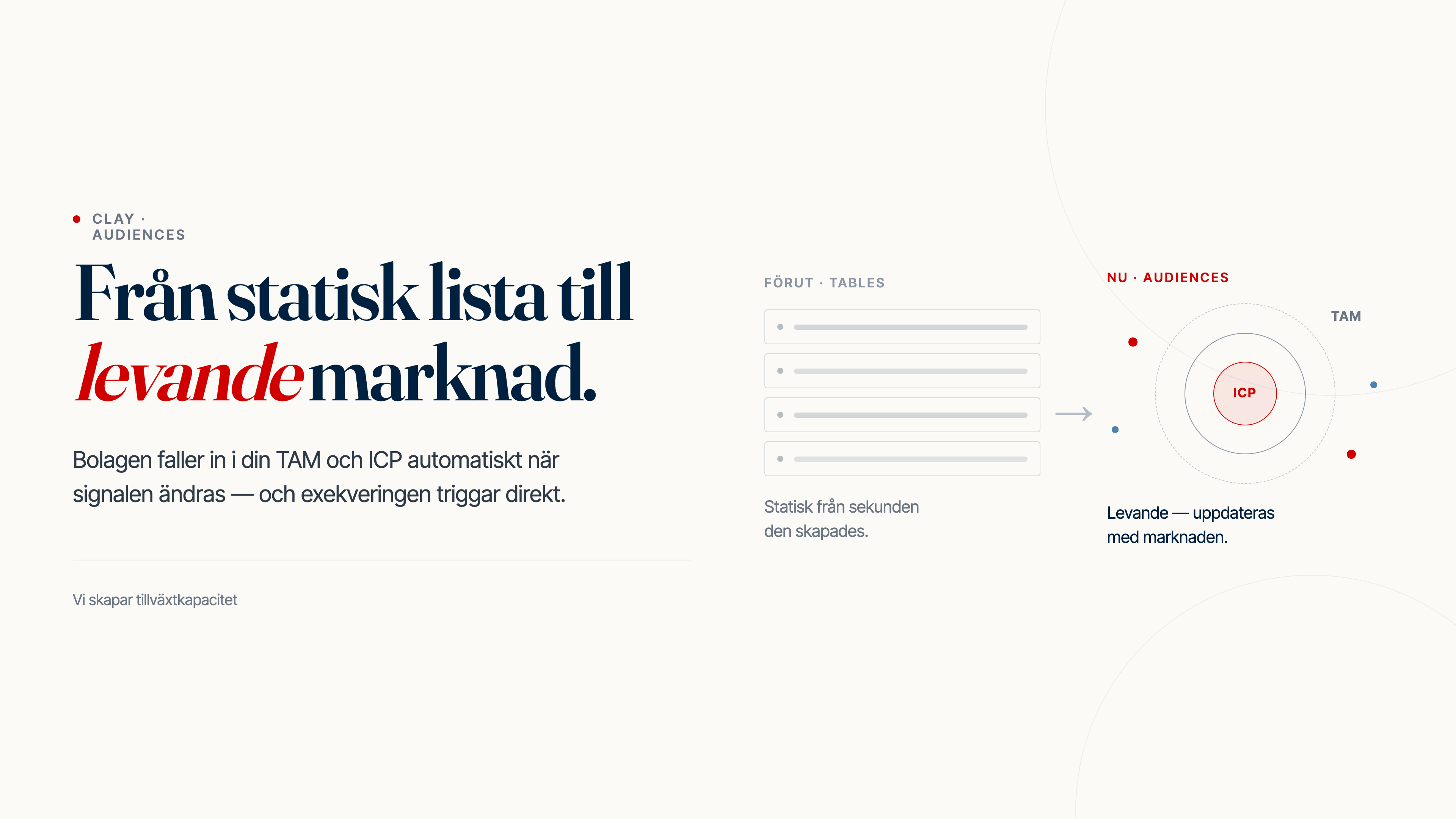
In Audiences, you gather your entire TAM in one place. Filter down to your ICP directly. One surface, one definition, one truth.
That alone is worth a product release. But it is not the big thing.
The big thing is that it is alive
Previously, you sourced a Table of companies. It was static from the second it was created. A week later it was wrong — companies had hired, changed tech stack, raised capital, grown or shut down. You did not know until someone manually updated the list.
Now it is the opposite. Audiences reads change in real time. When a company moves into your ICP, it moves into your surface. And the execution — message, sequence, task for a salesperson — can trigger immediately.
That is the difference between chasing a list and capturing a market in motion.
Two different disciplines. Chasing a list is about volume and cadence. Capturing a market in motion is about signal, timing and specific context. One is work. The other is architecture.
What it means for those of us building sales machines
For those of us building signal-driven sales machines for Swedish companies, this is not a feature.
It is the foundation.
We have been building around the lack of this for months — manually connecting tables, double-enriching contacts, building our own monitoring flows to catch when something changes. Audiences replaces that architecture with a primitive inside the platform itself.
What it opens up: less glue code, faster iteration on ICP, a tighter loop between signal and action, and — most importantly — the ability to build sales processes that react to reality instead of getting stuck in what was true last quarter.
Eleven releases left. If Audiences sets the tone, then it is not Clay that needs updating. It is how Swedish companies work with their market.