100% Use AI. 20.6% Can Show Results. What Are the 20.6% Doing Differently?
A survey from September: 100% of the revenue organisations surveyed say they use AI somewhere in their processes. Only 20.6% describe themselves as "production-ready with measurable results". 28.2% are still in the experimentation phase. The same survey explains why the gap exists:
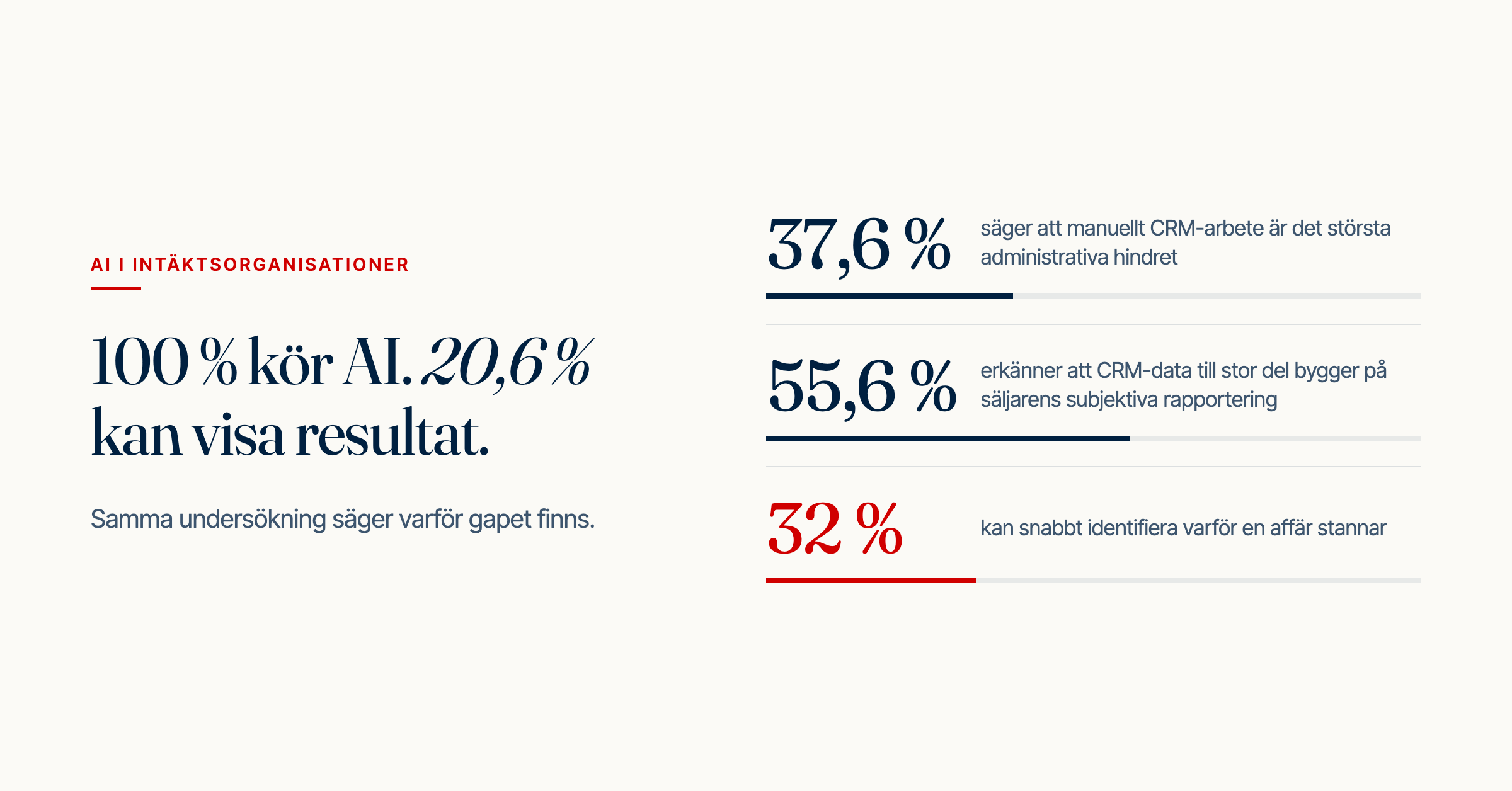
- 37.6% say manual CRM work is the biggest administrative obstacle
- 55.6% admit that CRM data is largely based on the salesperson’s subjective reporting
- Only 32% can quickly identify why a deal stalls
This is exactly the problem we at Mindwile have built our existence around. ###
Most B2B companies in our target audience have been buying parts of sales for a long time — leads, meetings, sales training, a CRM, now an AI tool — without ever owning a cohesive function. When one part does not deliver, they switch supplier and start again. And when AI is now layered on top of that, the result is the same: another tool in the stack, without a structure that makes it worth anything.
The 20.6% that can actually show results have done one thing in common. They laid the foundations first. They mapped their market. They enriched their data. They defined their pipeline stages. They synced everything back to a system they owned themselves. Then they layered AI on top — where it amplifies something that actually works.
The 79% that cannot show results do it the other way round. They buy the AI tool first. They hope it will clean the data, fix the process, organise what no one has defined. It never does. AI only amplifies what is already there. If the CRM is a passive archive today, it will be a faster passive archive tomorrow.
This is what we are building: a cohesive operating system for sales. Not another tool. Not another workshop. Not another role. The entire infrastructure — strategic foundation, prospecting engine, CRM architecture, pipeline cadence, measurement framework, enablement — in your own environment, owned by you, built in 3–4 months.
What to do on Monday: List your three most-used AI tools across sales and marketing. For each one, write one sentence about which measurable business result it produced in the last quarter. If you cannot put those sentences together, the problem is rarely the AI — it is that there is no structure around it that makes the result measurable.