"You may never log in to Salesforce again" — Salesforce is dissolving its own interface
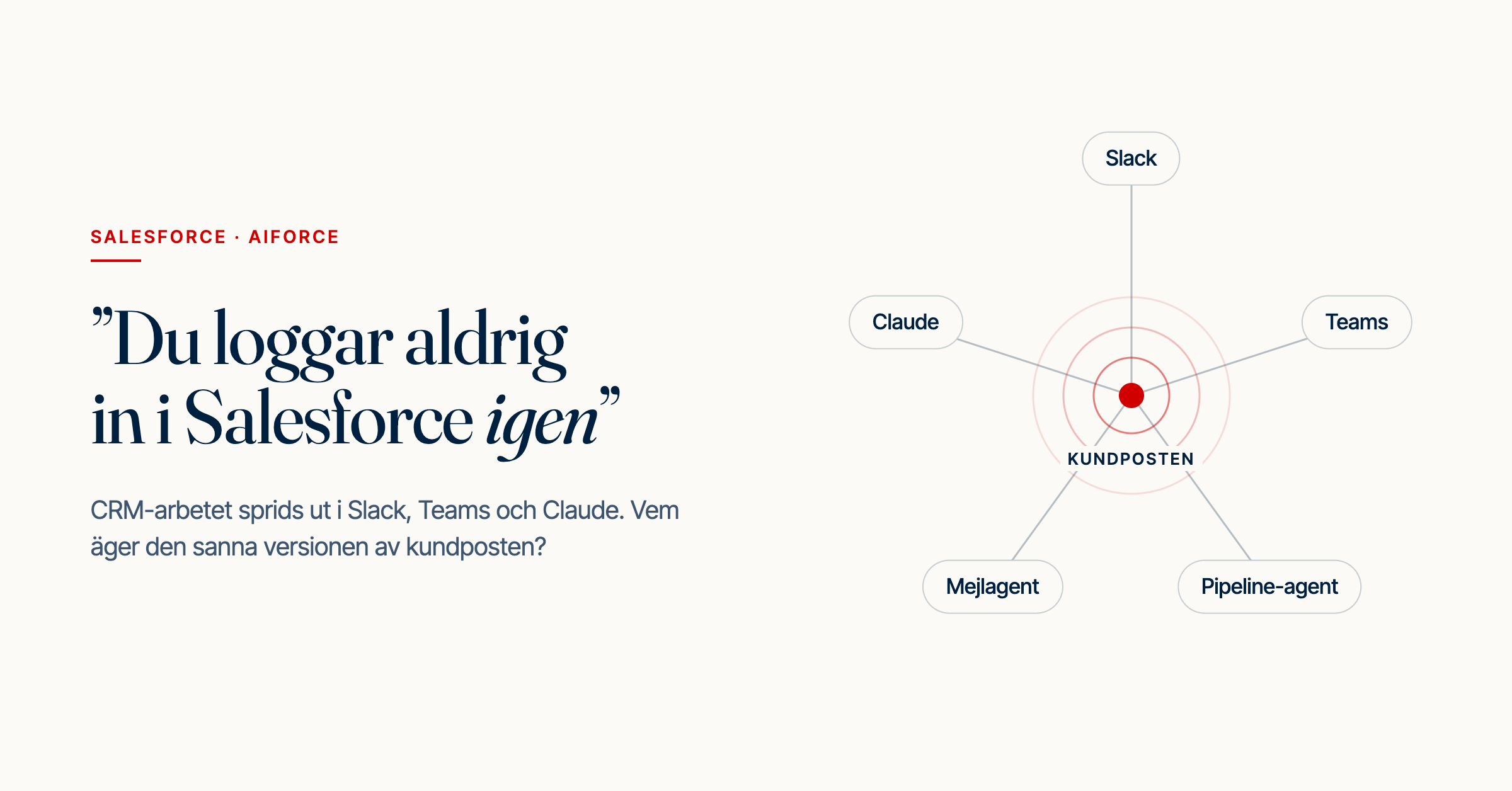
At Dreamforce (15 September), Salesforce launched AIforce — an agent interface layer that brings CRM data and functionality to where employees already work. Slack. Microsoft Teams. Claude. Not into Salesforce.
As part of the launch, Salesforce also introduced Claudeforce, a deepening of its Anthropic partnership, giving Claude Enterprise 37 pre-built sales skills (from prospecting to pipeline hygiene).
Salesforce co-founder Parker Harris said it himself: "You may never log in to Salesforce again."
Sounds liberating. And it is — until you ask the next question.
If every change can be made in Slack, in Teams, in a Claude conversation, an inbound email agent, a pipeline agent — who owns the true version of the customer record? Who knows who or what last touched it? Which agents are allowed to do what, and where is it logged?
This is exactly the governance question that analysts at MarketScale raised on 24 September. CRM work is being distributed — but responsibility for the record being complete and traceable does not move with it. It now has to be defined somewhere else.
And here comes the uncomfortable bit: the companies that will benefit most from AIforce are those that already have a locked-down CRM architecture — defined pipeline stages with exit criteria, field structures, hygiene rules, and an operating model. The agents then do exactly what you want them to do.
The companies that do not have that will discover their data problem at 100× speed.
What to do on Monday: Select five of your most important open deals in the CRM. Can you see, within two minutes, who last touched the record, in which system, and why? If not — your governance was already shaky. AIforce simply exposes it faster than you had imagined.