What happens to sales when Revenue Operations becomes a system?
There is a lot of talk about AI in sales. About automated prospecting. AI personalisation. Intent data. Signals. Agents. Enrichment. But the most important question is actually much simpler: Does sales actually get better? When you look at both research into Revenue Operations and concrete results from companies working in a structured way with platforms such as Clay, the answer is clear. The potential does not primarily lie in being able to send more emails. It lies in building a better system
Revenue Operations affects more than administration
Revenue Operations, or RevOps, is sometimes described as a way to get Sales, Marketing and Customer Success to work better together.
That is correct – but it understates its significance.
In practice, RevOps is about creating a shared engine for how a company:
- identifies the right market
- prioritises the right companies
- finds the right decision-makers
- detects buying signals
- qualifies inbound
- prioritises existing CRM accounts
- identifies expansion opportunities
- works the market
- manages data
- follows up on activities
- measures pipeline and revenue
When this operates as separate processes, it almost always creates manual work, poor data, duplicated effort and missed business opportunities.
When it is instead built as a connected system, something else happens.
Salespeople can spend significantly more time selling.
Companies with better Revenue Operations perform better ### Research from Forrester has shown that organisations with strong alignment across their revenue functions have seen:
19% faster revenue growth
and
15% higher profitability.
Accenture has also found that companies with weak alignment between Sales, Marketing and Customer Success can have significantly lower deal close rates.
At the same time, what is interesting is that very many organisations are still early in their development.
Companies have CRM systems.
They have marketing automation.
They have data providers.
They have sales tools.
But between the systems, there are still people manually moving information, doing research, building lists, qualifying companies, prioritising accounts and updating CRM.
This is where the next generation of Revenue Operations starts to become interesting.
Clay changes how RevOps can be built ### Clay has often become known as a tool for prospecting and enrichment.
And many still associate Clay with automated outbound.
But when you look at how more advanced organisations use the platform, a different picture emerges.
Clay is not just the engine for outbound. It can be the engine behind large parts of the operational Revenue Operations process – even when no automated outreach is sent at all. Clay can function as an operational layer between:
CRM + data sources + AI + signals + automation + the sales team.
Instead of a salesperson having to carry out the entire process themselves, the system can continuously do large parts of the work.
For example:
Data → ICP → signals → prioritisation → research → routing → CRM → activity
In some cases, the flow continues onwards to personalised outreach.
In other cases, it ends with the right salesperson getting the right account, the right information and the right reason to act.
That is an important distinction.
Revenue Operations without automated outreach ### Think, for example, of a company that already has 20,000 accounts in its CRM.
The problem may not be that they need another 20,000 prospects.
The problem may instead be that no one really knows:
- which accounts actually fit the ICP
- which should be prioritised right now
- which have recently been hiring
- which have changed leadership
- which have received funding
- which have opened a new market
- which use a competing solution
- which customers have expansion potential
- which old opportunities have become relevant again
Here, Clay can work continuously in the background with data, enrichment, research and signals.
The result does not have to be an automated email.
The result could be:
“These 37 existing accounts are the ones your sales team should speak to this week – and here is why.”
That is Revenue Operations.
What actual results are we seeing? ## When you look at companies working with Clay in a structured way, there are several interesting examples.
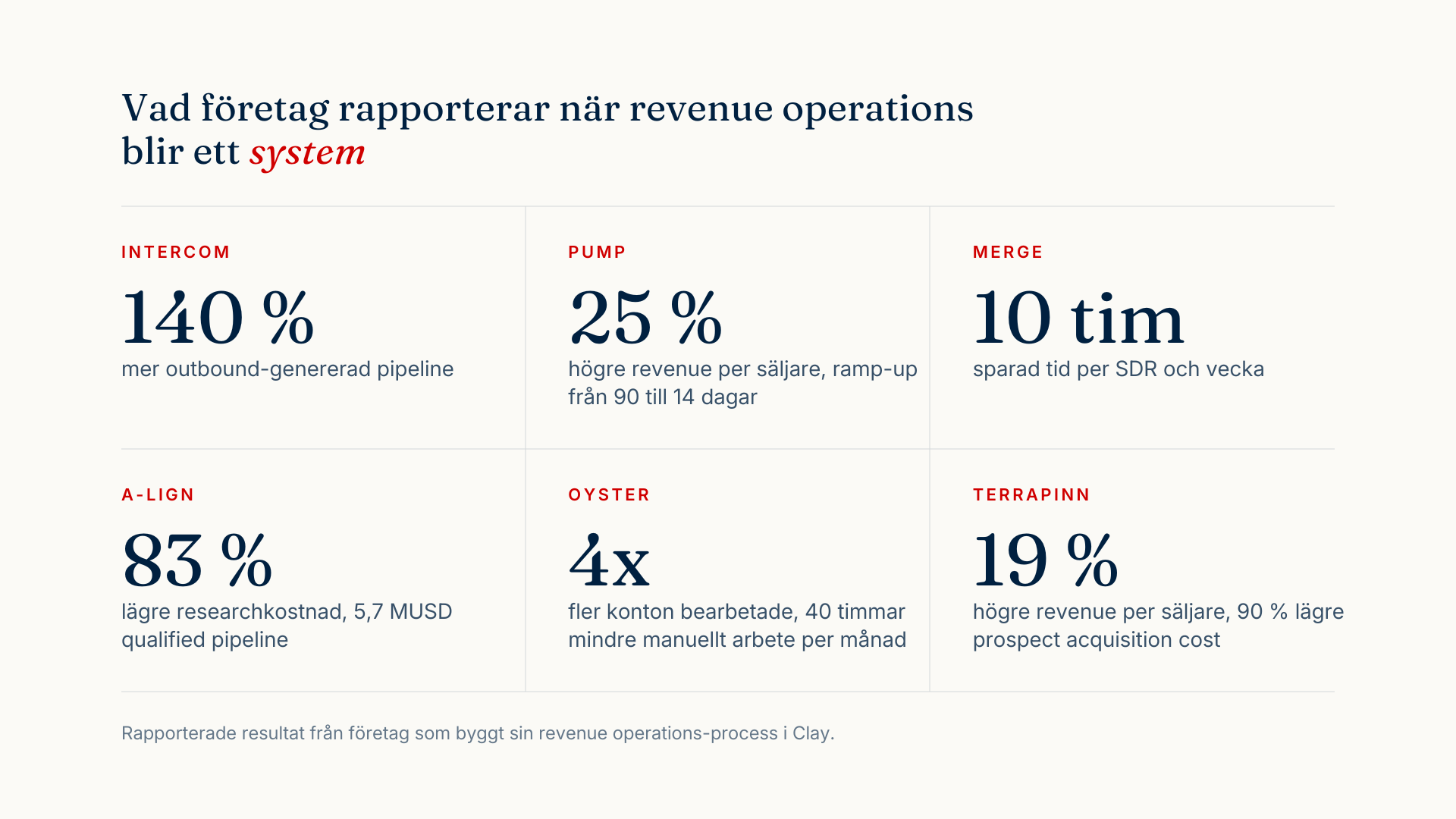
Intercom: 140% more outbound-generated pipeline ### Intercom used Clay to automate, among other things, TAM and ICP research, enrichment and the distribution of accounts to the sales organisation.
The result: ### A 140% increase in outbound-sourced pipeline.
List-building processes that previously took days could also be completed in minutes.
What is interesting here is not just the outbound result.
It is that the work of identifying, analysing and distributing the right accounts became a system process instead of manual sales work.
Pump: 25% higher revenue per salesperson ### Pump built a more automated process for ICP research, territories and account intelligence.
The result:
30% more booked meetings
25% higher revenue per salesperson
and ramp-up for new salespeople went from around:
90 days to 14 days.
This is a good example of why Revenue Operations should not only be measured by the number of leads.
It affects productivity across the entire sales organisation.
Merge: more sales and less research ### Merge uses AI and automated research to identify and prioritise relevant enterprise accounts.
The result:
15% more enterprise meetings
20% higher response rate
and more than:
10 hours of time saved per SDR per week.
That is equivalent to more than one working day every week that can be used for customer conversations instead.
A-LIGN: from research cost to pipeline ### A-LIGN automated, among other things, account research, competitive research and CRM processes.
They reported:
USD 5.7 million in qualified pipeline
USD 3.3 million in closed revenue
as well as:
83% lower research cost.
This illustrates one of the major changes that AI and RevOps bring.
Research that was previously expensive human work becomes an automated part of the infrastructure.
Oyster: four times more accounts
Oyster combined intent signals with automated enrichment, segmentation and outbound.
The result:
4x more accounts could be worked
while roughly:
40 hours of manual work per salesperson per month could be eliminated.
In practice, that is a whole working week every month.
Terrapinn: 19% higher revenue per rep
Terrapinn automated sourcing, enrichment and ICP analysis.
They reported:
19% higher revenue per salesperson
as well as:
90% lower prospect acquisition cost.
Again, the same pattern is visible.
It is not just about generating more leads.
It is about changing the economics of the sales process itself.
The real change: moving work from people to systems
Look at the working day of a traditional B2B salesperson.
A large part of the time can be spent on:
finding companies
checking whether the company fits the ICP
looking for contacts
understanding the organisation
doing research
prioritising which accounts to work
preparing for meetings
writing messages
updating CRM
following up on previous activities.
This is work that has historically been necessary.
But much of it no longer really requires a human.
A modern Revenue Operations engine can do large parts of it automatically.
That does not mean the salesperson disappears.
Quite the opposite.
It makes the salesperson’s time more valuable.
The salesperson can instead focus on what humans are still significantly better at:
understanding needs
having real conversations
building trust
navigating complex buying decisions
and closing deals.
Clay can be used far beyond prospecting
A modern Clay setup can, for example, be used to: ### - prioritise existing CRM accounts - identify expansion among existing customers - detect buying signals - enrich and improve poor CRM data - qualify inbound - route leads to the right salesperson - carry out account research before meetings - give AEs better account intelligence - identify old opportunities that have become relevant again - analyse TAM and ICP - trigger tasks in CRM - identify churn or upsell signals - automate parts of lead scoring - create personalised outreach when that is actually the right next step - Automated outreach is therefore one possible output.
It is not the whole system.
Clay is therefore not just a lead generation tool
That is perhaps the most important conclusion.
Describing Clay as a tool for building lists or sending automated outreach misses a large part of what is happening in modern GTM.
In a more advanced setup, Clay becomes part of the company’s Revenue Operations infrastructure.
It can continuously:
- identify companies within the ICP
- enrich CRM data
- detect signals
- prioritise accounts
- carry out AI-based research
- identify the right people
- distribute leads to the right salesperson
- trigger activities
- keep CRM updated
- and, when relevant, create personalised outreach.
The company then moves from campaign-based prospecting to a continuously working Revenue Engine.
A concrete example
Imagine a salesperson logging in in the morning.
Instead of starting by searching on LinkedIn, checking CRM, reading company websites and trying to work out who should be contacted, there is already a prioritised list.
The system has, for example, detected that:
Company A has hired a new CRO.
Company B has opened operations in Germany.
Company C has started using a competing technology.
Company D has been a customer before and has now grown by 40%.
Company E has visited relevant parts of the website and matches the ICP.
For each account, there is relevant research, the right decision-maker and why the account should be prioritised.
##The salesperson’s task is no longer:##
“Who should I contact?”
but:
“How do I create the best possible dialogue with these five companies?”
That is a completely different sales model.
The best sales organisation of the future does not need to have the most salespeople
This leads to a bigger question.
What will successful sales organisations look like in a few years’ time?
We do not necessarily believe the winner will be the company with the most SDRs or the largest sales organisation.
It could just as easily be the company that has built the best system around its salespeople.
A system that continuously:
finds the right companies
sees when something changes
understands why the company is relevant
prioritises the right account
surfaces the right information
and presents the next best activity for the salesperson.
That is where Revenue Operations, AI and platforms such as Clay start to merge.
And that is where we believe a large part of the productivity increase in B2B sales will take place over the coming years.
From more activities to better Revenue Operations
The question for companies therefore becomes less:
“How do we get our salespeople to do more activities?”
and increasingly:
“How do we build a system in which our salespeople only need to do the activities where humans actually create value?”
That is a fairly fundamental shift.
And companies that succeed with that shift can gain a significantly more scalable sales organisation – without headcount needing to grow at the same pace as pipeline.
<hr>
###Would you like to see how a Revenue Engine could be built for your company?###
At Mindwile, we help B2B companies combine Revenue Operations, Clay, CRM, AI and automation to create a more systematic and scalable sales process. Not just for outbound. But across the entire journey from data and prioritisation to pipeline and revenue. Contact us and we will show you what it could look like in practice.